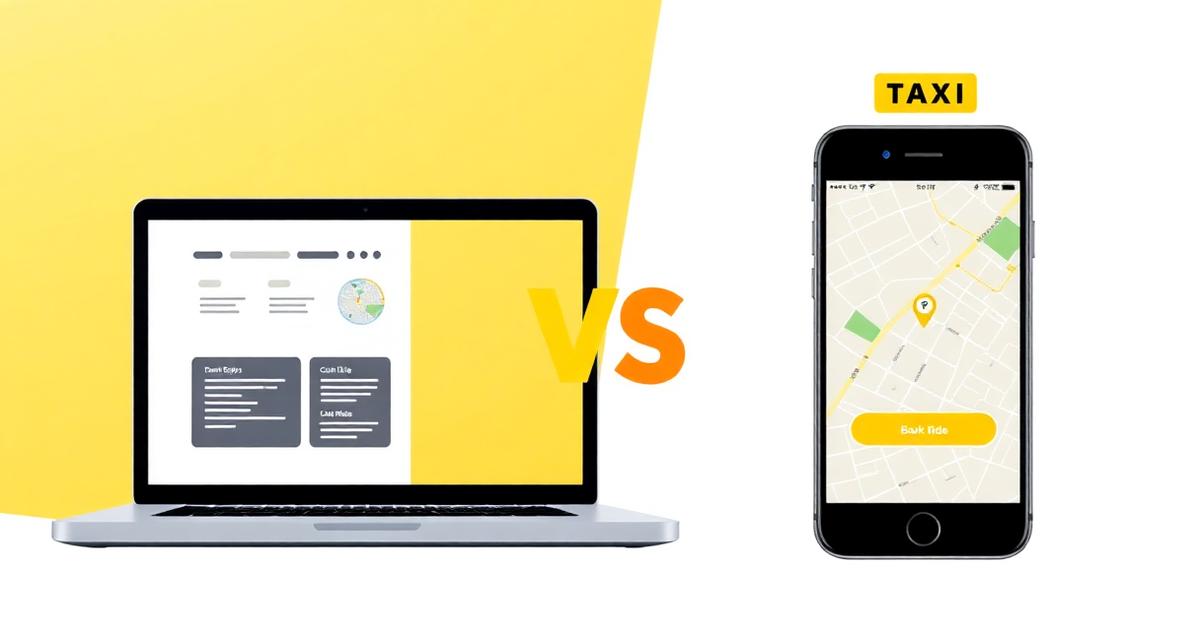
This is the question every growing taxi, limo and chauffeur operator runs into the moment they take online bookings seriously: do you need a taxi booking widget on your website, a branded native passenger app, or both? The answer changes with your booking volume, your customer base, and what you're trying to optimise for. This guide gives you the operator-grade framework — no marketing fluff.
What a Booking Widget Actually Is
A booking widget is an embeddable form that lives on your existing website. The customer lands on your homepage, sees pickup/drop-off fields, types in their journey, sees a fare estimate, picks a vehicle class, pays (or chooses cash), and gets a confirmation — all without leaving the browser, downloading anything, or creating an account. The whole flow happens in 60–90 seconds.
The widget is a thin layer over the same backend that runs your dispatch console and driver app. The booking lands on your dispatcher's screen the same way as any other job.
What a Native Passenger App Is
A native passenger app is a branded iOS and Android app published to the Apple App Store and Google Play under your business name. The customer downloads it once, allows location, and can rebook in two taps from their home screen for the rest of their relationship with you. See our white-label option at passenger app.
Apps offer push notifications, saved payment methods, ride history, and a first-class on-screen experience. They cost more to build, more to maintain, and are slower to launch than a widget — but they retain customers in a way no website ever can.
The Operator Decision Framework
Here is the framework most operators should use, plotted against the two axes that actually matter: weekly online booking volume and the share of repeat customers in your business.
| Stage | Weekly online bookings | Recommendation |
|---|---|---|
| Just starting | 0–50 | Widget only. Launch in days. No app overhead. |
| Growing | 50–150 | Widget primary, app on roadmap. Add app within 6 months. |
| Scaling | 150–500 | Widget + app. Both running. Push corporate accounts to app. |
| Mature | 500+ | Widget + app, optimised. Heavy app investment, widget for new acquisition. |
Booking Widget — Where It Wins
- Conversion of first-time customers. Widget conversion rates run 8–14% of visitors. App-install conversion runs 1–3% on first contact. The widget removes the install-then-account-then-book friction entirely.
- Speed to market. A widget can be live on your existing website in 24–72 hours. An app takes 4–8 weeks including App Store review.
- SEO leverage. A widget on your homepage gives Google a clear conversion action to attribute. Apps don't help organic search rankings.
- Cost. Included free in Taxi Web Design's Enterprise plan from $8,500. Even standalone widget products typically cost $50–$200/month — orders of magnitude cheaper than a custom-built app.
- Universal device coverage. Works on every smartphone, tablet, and desktop browser without download.
Native Passenger App — Where It Wins
- Customer retention. App users rebook 4–7x more often than web-only customers. The app icon on the home screen is a permanent reminder.
- Push notifications. Driver-on-the-way, driver-arrived, and rate-your-ride notifications drive repeat behaviour. SMS works but push is free, faster, and more flexible.
- Saved payment + saved addresses. Two-tap rebooking is impossible in a browser session that doesn't survive cookies being cleared.
- Brand permanence. Customers who downloaded your app five years ago still have it on their phone. Browser bookmarks don't survive that long.
- Corporate accounts. Business travellers strongly prefer apps for ride history, expense codes, and per-trip notes. If 30%+ of your work is corporate, the app pays for itself fast.
Where Each One Loses
Booking widget weaknesses: low retention (no permanent customer touch-point), no push notifications, dependent on the customer remembering your URL, can't be discovered in App Store search.
Native app weaknesses: install friction kills first-time conversion, App Store review delays every update, requires ongoing iOS/Android maintenance, useless to customers who haven't installed it yet.
Why Most Growing Operators Run Both
The widget and the app aren't competitors — they handle different stages of the customer lifecycle:
- Acquisition happens through the widget. Someone Googles "taxi to Manchester airport", lands on your homepage, books in 90 seconds, and you've got a new customer.
- Retention happens through the app. After their first ride, you prompt them to download the app for "$5 off your next ride" or simply "two-tap rebooking next time". From that point on, they live in the app.
Operators who do this well typically see widget-acquired customers convert to app users at 25–40% within 60 days, and those app users go on to book 5x more often than web-only customers.
The Cost Comparison That Actually Matters
| Option | Upfront | Monthly | Time to launch |
|---|---|---|---|
| Widget only (Taxi Web Design) | Included in $8,500 Enterprise | ~$250 hosting | 2–7 days |
| App only (custom build) | $40k–$120k | $2k–$5k maintenance | 4–8 months |
| Widget + branded app (Taxi Web Design) | $8,500 Enterprise | ~$250 hosting | 14–21 days both live |
The bundled white-label model is the only one that's even economical for an independent operator. Custom app builds are reserved for venture-funded startups or operators with $1m+ to allocate to engineering. See full pricing on the pricing page and the chauffeur-specific build at chauffeur booking software.
Implementation: Widget First, App Second
- Week 1: Embed the booking widget on your homepage. Connect your dispatcher console. Run 5 test bookings end-to-end.
- Week 2: Marketing — update Google Business Profile, run a £200 Google Ads test driving to the widget. Measure the conversion rate.
- Weeks 3–4: Hit 50+ weekly online bookings? Brand the passenger and driver apps. Submit to App Store and Play Store.
- Weeks 5–8: Apps go live. Email and SMS your existing customer base with a download link and a one-time discount code. Track install rate.
- Month 3+: Optimise. App-only promotions, push notifications for off-peak deals, corporate account onboarding through the app.
Common Mistakes Operators Make
Mistake 1: skipping the widget and going straight to the app. You spend 6 months and $80k on an app that 2% of website visitors install. Most of your potential bookings die at the install screen.
Mistake 2: launching only the widget and ignoring retention. You take great first-bookings but they never come back because nothing reminds them you exist. SMS and email help, but they don't replace an app icon.
Mistake 3: building a custom app for a 10-vehicle fleet. A custom app at $80k is roughly 10x what a 10-vehicle fleet should be spending on technology. White-label is the only sensible model at that scale.
Mistake 4: choosing a vendor that charges per-booking commission. Per-booking fees of 2–5% sound small until you do the maths on 500 monthly rides at £30 average — that's £300–£750/month in pure commission to a vendor. Flat platforms beat commission models in almost every case.
The Right Answer for Most Operators
If you're under 50 weekly online bookings, launch the widget this month and put the app on your 6-month roadmap. If you're already past 50–100 weekly bookings, do both — the widget pays back in new acquisition, the app pays back in retention, and on a single platform like Taxi Web Design they share the same dispatch backend so there's no duplication of operational work.
The wrong answer is doing nothing because you can't decide. Online bookings now account for 60%+ of taxi industry revenue in mature markets — operators still running phone-only are losing share every quarter.
Bottom Line
The widget vs app debate is a false choice for any operator past the early-stage. Widget for acquisition, app for retention, both running on the same backend. That's the model that scales from 5 vehicles to 500.
See our booking widget, the passenger app, and the chauffeur-specific build at chauffeur booking software. Ready to launch? Book a live demo and we'll show you both running on real bookings in 30 minutes.