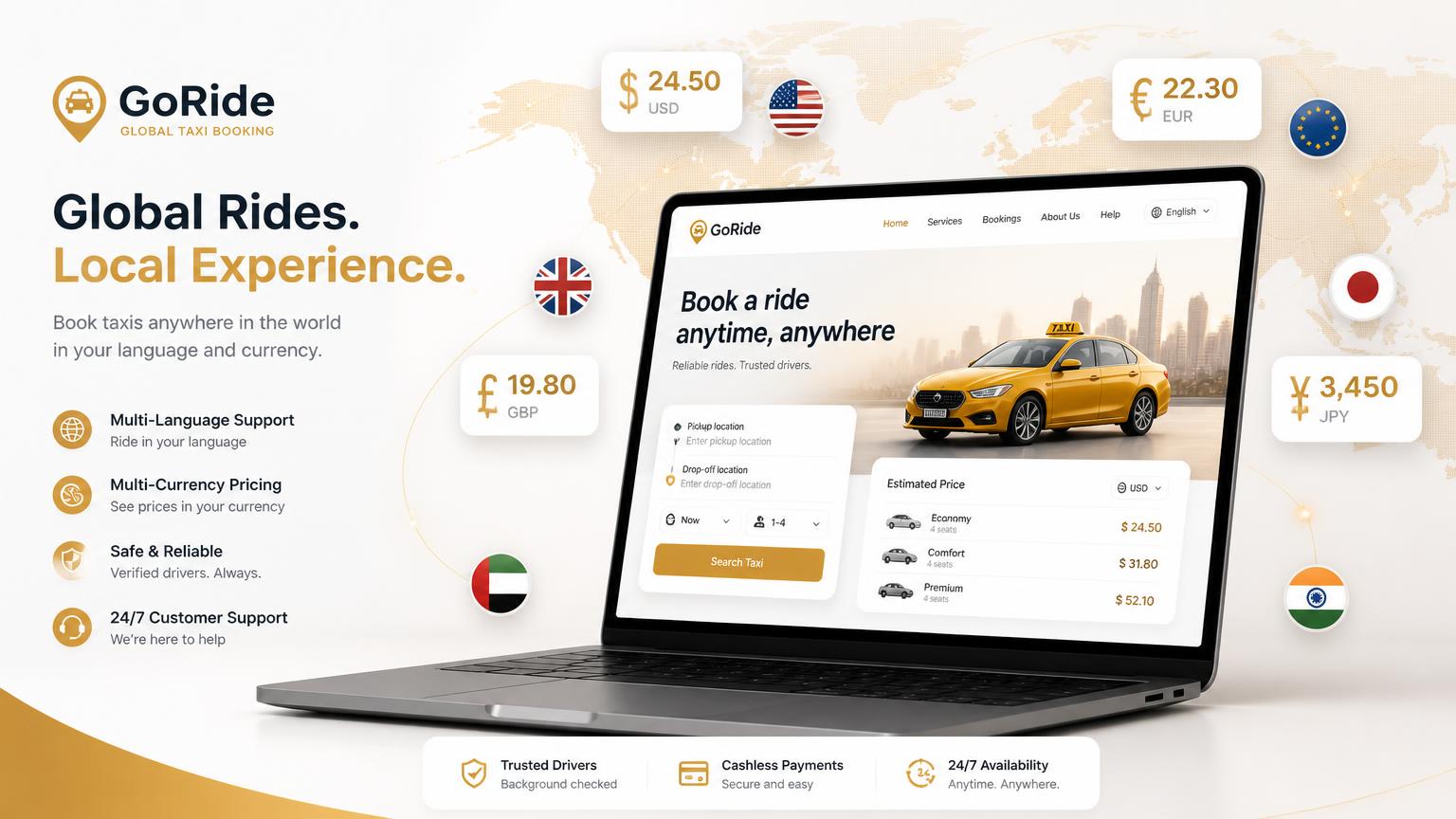
An operator in Lisbon told us something that explains this entire article. His airport transfer page converted well for Portuguese visitors and almost never for anyone else — even though the overwhelming majority of his traffic came from the UK, Germany, France and the United States. The site was in English, the fares were in euros, and the booking form asked for a postcode in a Portuguese format.
None of that is a taxi problem. It is a checkout localisation problem, and it is measurable: travellers routinely abandon a booking when the price is shown in a currency they cannot instantly evaluate, and again when the confirmation screen is in a language they cannot read. For airport, cruise, hotel and corporate transfer operators, that is not an edge case — that is most of the demand.
This article explains how automated local currency and automated local site language actually work, what they change commercially, where the common implementations fail, and what we ship in our Global plan at $1,299 setup plus $40 per month.
Why localisation decides international transfer bookings
A transfer booking is a low-consideration purchase made under stress: someone is planning arrival logistics for a trip weeks away, usually on a phone, usually comparing two or three tabs. Every second of mental arithmetic is friction.
Three specific frictions kill these bookings:
- Currency ambiguity. A German traveller shown "£95" does not know whether that is reasonable for a 40-minute airport run. Shown "€111", they decide immediately.
- Language friction. Passengers will read a marketing page in English and still refuse to enter card details on a form they only half understand. Trust collapses precisely at the payment step.
- Statement mismatch. Quoting in one currency and charging in another produces a card statement that does not match the confirmation email. That generates support tickets and chargebacks.
The fix is not a translate button in the footer. It is a booking flow that presents itself as local from the first page view to the confirmation email.
How automated local currency detection works
Currency localisation on a booking site has four moving parts, and most cheap implementations only build the first one.
1. Detection
The site resolves the visitor's country from their IP address and cross-checks it against the browser's language and region settings. A visitor in Frankfurt with a de-DE locale defaults to euros; a US traveller on holiday in Frankfurt with an en-US locale is offered dollars, because the currency that matters is the one on their card, not the one under their feet.
2. Conversion
Your fare engine keeps one base currency — the one you invoice and account in. Display prices are converted with exchange rates refreshed daily from a reference feed, with an optional buffer margin so a mid-week FX swing never sells a job below cost. The base fare rules, surcharges and account pricing never fork per market.
3. Presentation
Correct localisation is more than a symbol swap. Decimal separators, thousands separators, symbol position, distance units (km versus miles), 12-hour versus 24-hour times and date order all change per locale. A German passenger seeing "€1.234,50" and "14:30" reads a professional operator. Seeing "€1,234.50" and "2:30 PM" reads an American template with a currency filter.
4. Charging
Finally the checkout charges in the displayed currency. This is where most bolt-on currency widgets stop being honest: they convert the display but hand Stripe the base amount, so the passenger is quoted €111 and billed £95 plus their bank's own conversion. Ours passes the displayed currency straight through to the payment intent.
How automated local site language works
There are three ways to translate a booking site, and they are not equivalent.
| Approach | Indexable in Google | Booking flow translated | Typical cost |
|---|---|---|---|
| Browser / widget overlay | No | Partially, breaks on dynamic fares | Free |
| Separate site per language | Yes | Yes, but duplicated maintenance | $$$ per language |
| Localised routes + hreflang (Global plan) | Yes | Yes, including emails | $1,299 + $40/mo |
The Global plan uses the third model. Every language gets a real URL path, reciprocal hreflang annotations and its own indexable metadata, so a Spanish searcher can land directly on the Spanish page instead of an English page they will bounce from. Booking confirmations, SMS templates and driver-arrival notifications inherit the same language the passenger booked in.
Arabic and Hebrew get genuine right-to-left layout — mirrored navigation, form alignment and iconography — rather than RTL text poured into an LTR template, which is the usual giveaway of an overlay translation.
What it is worth: a simple model
Take an operator running 120 transfer enquiries a month, 60% of them from overseas visitors, at an average job value of $85.
- 72 international enquiries per month
- Baseline conversion on an English-only, single-currency site: roughly 8% → 5.8 jobs → $490/month
- Conversion after currency and language localisation: a conservative uplift to 12% → 8.6 jobs → $735/month
- Difference: ~$245/month, against a $40/month running cost
On those numbers the $1,299 setup pays back in roughly six months, and every month after that the plan runs at a 6× return on its subscription. Run your own version of that arithmetic with our cost calculator before you commit — if under a fifth of your work is inbound, the numbers will tell you to stay on Premium.
Where the Global plan sits in our pricing
We sell two products: a branded booking website, and a full owned dispatch platform. The Global plan is the top tier of the website product.
- Starter — $399 setup + $10/month. One to three vehicles, single market, single currency.
- Premium — $699 setup + $30/month. Growing chauffeur and limo operators wanting a premium brand, advanced fare rules and hourly/wedding modules.
- Global — $1,299 setup + $40/month. Everything in Premium plus automated local currency, automated local site language, RTL support, hreflang SEO, localised emails and multi-currency checkout.
- Enterprise Dispatch — from $8,500 one-time. Branded passenger and driver apps, dispatch console, fleet management and source-code ownership.
No plan charges a per-trip commission or a per-driver fee. Full detail is on the pricing page.
Who should buy the Global plan
It is the right choice if you recognise yourself in any of these:
- Airport transfer operators whose enquiries arrive from origin countries, not the destination city.
- Cruise port operators handling mixed-nationality manifests with pre-booked shore transfers.
- Chauffeur companies serving corporate visitors, where the traveller's PA books from head office abroad.
- Operators in non-English-speaking markets who need both a local-language site and an English one that ranks.
- Multi-country networks quoting the same fleet in two or three currencies.
It is the wrong choice for a purely local, single-language operation — that is what Starter and Premium exist for.
Implementation: what the first two weeks look like
- Days 1–2. Base currency, fare rules and market list confirmed. We identify your top five source countries from your existing analytics.
- Days 3–5. Site build with localised routes scaffolded, FX feed connected, buffer margin set.
- Days 6–9. Translation pass across pages, booking flow, validation messages, emails and SMS. Native review on your primary two languages.
- Days 10–12. Hreflang, sitemaps and per-language metadata; Search Console international targeting.
- Days 13–14. Multi-currency checkout testing with real card and Wise transfers, then go live.
Common mistakes to avoid
- Machine-translating fare terms. "Waiting time", "meet and greet" and "cancellation window" carry contractual meaning. These get human review, not raw MT.
- Detecting language from IP alone. A Dutch traveller in Spain wants Dutch or English, not Spanish. Locale beats geography for language; geography beats locale for regulations.
- Forgetting the emails. A translated site with an English confirmation email undoes the trust you just built.
- No manual override. Always ship visible currency and language switchers. Detection is a default, never a lock.
- Ignoring rounding. €110.87 looks like a machine. €111 looks like a price. Round display fares to a clean local increment.
Related reading
- World Cup 2030: launching a $399 web booker in Spain, Portugal and Morocco
- Best limo dispatch software in 2026
- The $399 web booker for small taxi, limo and chauffeur operators
- Full pricing: Starter, Premium, Global and Enterprise
Sell in every currency your passengers carry
The Global plan is $1,299 one-time setup plus $40 per month — automated local currency, automated local site language, multilingual SEO and multi-currency checkout, with no per-trip commission.