Affiliate disclosure: Taxi Web Design is an affiliate partner of BabyLoveGrowth.ai. If you sign up through the links on this page we may earn a commission at no extra cost to you. We only recommend tools we run on our own websites.
Manual link building is the least enjoyable job in marketing and the easiest to abandon. You build a prospect list, write personalised pitches, follow up twice, and land somewhere between two and five per cent. To earn ten links you send several hundred emails, and a meaningful share of the replies ask for money anyway.
The alternative that works in 2026 is not "buy links". It is placement through a curated publisher network, where relevance is the selection criterion. Here is how that model works and where the line sits.
Why links still decide competitive rankings
Two sites publish equally good articles on the same query. One has eleven references from established sites in adjacent industries; the other has none. The first wins, and it will keep winning, because links remain the strongest available proxy for whether anyone outside your own marketing department considers the page worth pointing at.
There is a second reason links matter now that did not exist three years ago. Assistants such as ChatGPT, Perplexity and Gemini draw heavily on pages that rank well and are widely referenced. Links feed rankings; rankings feed AI citations. The chain is covered in how to get cited by AI search engines.
What separates a valuable link from a worthless one
| Attribute | Valuable link | Worthless or harmful link |
|---|---|---|
| Placement | In the body of an article | Footer, sidebar, author bio farm |
| Relevance | Same or adjacent topic | Unrelated: casino, crypto, generic news |
| Anchor text | Descriptive and varied | Identical exact-match, repeated |
| Host site | Real audience, indexed, updated | Thin PBN with no organic traffic |
| Pace | Steady over months | 200 links in a week |
Every "we got penalised by link building" story fails at least two rows of that table. The model itself is not the problem; the execution is.
How a 4,000-site contextual network actually works
The mechanics are simpler than the mystique suggests. A network is a pool of real, independently operated sites that publish content and accept relevant contributions. BabyLoveGrowth.ai matches your topic against that pool, so a chauffeur operator does not end up linked from a gardening blog.
- Topic matching. Your target page is classified by topic and intent, then matched to network sites publishing in that space.
- Contextual placement. The link is written into the body of a genuinely relevant article rather than bolted onto a list page.
- Anchor variation. Anchors rotate between branded, partial-match and natural phrases so no single pattern dominates.
- Paced delivery. Placements are spread across weeks so the profile grows the way a real one does.
- Alignment with content. Because the same platform is publishing your articles, links point at pages that were built to receive them.
That last point is the one most people miss. Links to a homepage that never changes do far less than links arriving at fresh, specific pages that are already targeting the query.
Stop sending cold outreach emails
Contextual placements from a 4,000-plus site network, matched to your topic and paced naturally — running alongside the articles the same platform publishes for you.
Start free 👉 See our SEO automation stack
Start free 👉 babylovegrowth.ai
Outreach versus network placement, honestly compared
| Manual outreach | Network placement | |
|---|---|---|
| Time per link | 3–6 hours | Minutes of review |
| Reply / success rate | 2–5% | Deterministic |
| Cost per placed link | $150–$600 all-in | Bundled in subscription |
| Editorial control | Low — editor decides | Moderate — anchor and target chosen |
| Best for | Digital PR, flagship assets | Steady authority on money pages |
The mature answer is both. Use network placement as the base load that keeps authority growing every month, and keep a little outreach capacity for the genuinely newsworthy asset — original data, a survey, a tool.
A safe 90-day link plan for a small site
- Days 1–30. Fix internal linking first. Every commercial page should be reachable in two clicks from the homepage. Publish eight to twelve articles that deserve links.
- Days 31–60. Begin paced placements, three to five per month, pointed at your strongest commercial pages and best new articles. Keep branded and partial-match anchors dominant.
- Days 61–90. Review which target pages moved. Concentrate the next round on pages sitting in positions eleven to twenty, where a small authority lift converts into page-one visibility.
The mistakes that cause damage
Exact-match anchor text used on every link. All placements pointed at one page. Two hundred links in the first fortnight. Sites chosen by domain rating alone with no check for real traffic. Nothing published on your own site to justify the attention. Avoid those five and paced contextual placement is one of the lowest-risk growth levers available to a small business.
Content and backlinks from one platform
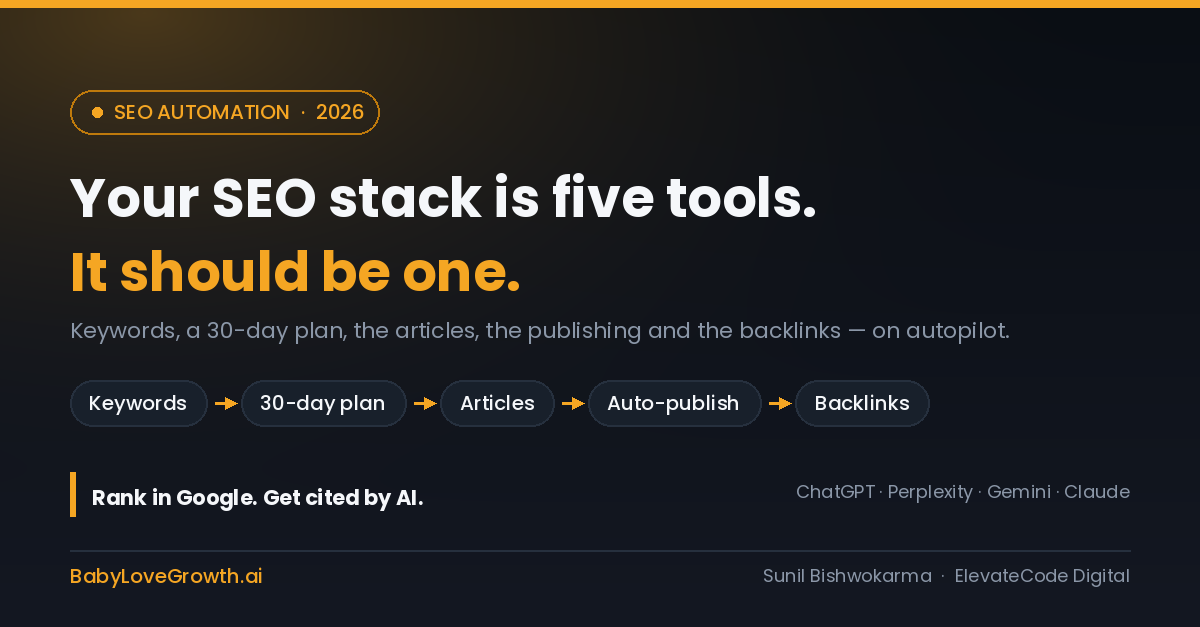
The same subscription that writes and publishes your articles also builds the contextual links pointing at them. One workflow, one bill.
Start free 👉 See our SEO automation stack
Start free 👉 babylovegrowth.ai