Affiliate disclosure: Taxi Web Design is an affiliate partner of BabyLoveGrowth.ai. If you sign up through the links on this page we may earn a commission at no extra cost to you. We only recommend tools we run on our own websites.
We run this website. We also run booking sites for taxi, limo and chauffeur operators across four continents, which means we watch the same failure repeat every single month: the operator knows exactly which searches would bring them work, agrees a content plan, publishes two articles, and then a busy airport week arrives and nothing else goes live for a quarter.
SEO is not usually lost on strategy. It is lost on cadence. That is the specific problem BabyLoveGrowth.ai is built to solve, and this review covers what it does, how it performed for us, and who should ignore it.
What BabyLoveGrowth.ai is
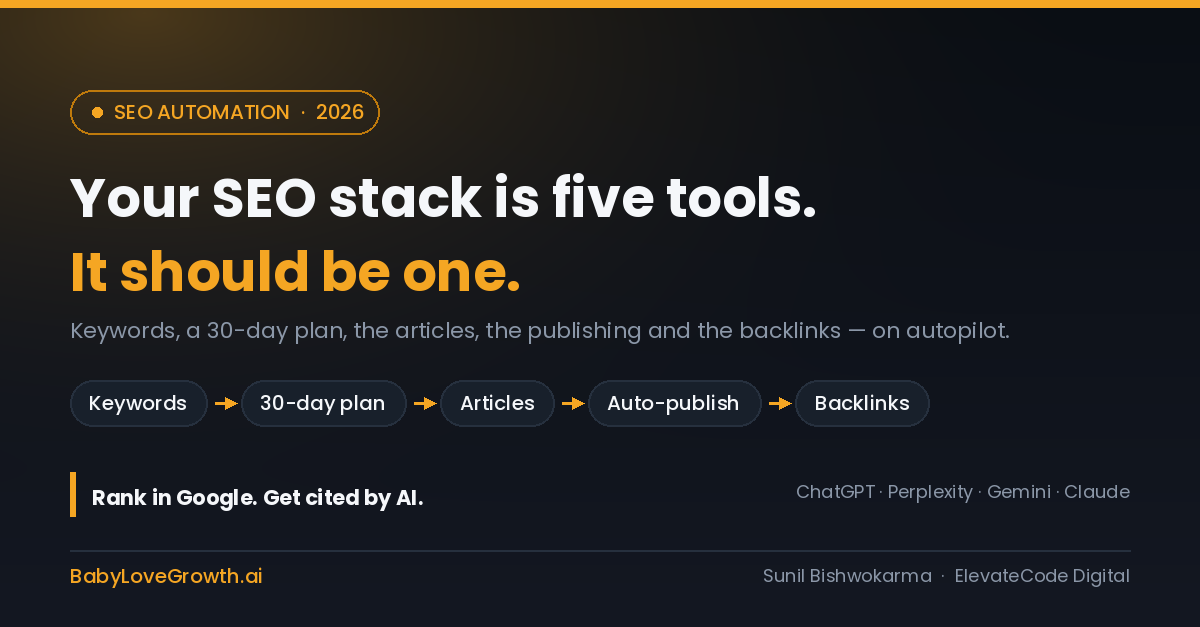
It is an SEO autopilot: a single platform that runs the loop from keyword to published page to backlink, without you assembling five separate tools. The loop has four stages.
- Keyword discovery. It reads your site, works out what you sell and to whom, and returns keyword clusters weighted by realistic difficulty rather than raw volume.
- A 30-day plan. Those clusters become a dated editorial calendar, so the pipeline is visible a month ahead instead of being decided the morning of publishing.
- SEO-ready articles. Each piece ships with a heading structure, internal links to your existing pages, meta title and description, FAQ blocks and schema markup already in place.
- Direct publishing. The finished article is pushed to your CMS on schedule. WordPress, Webflow, Shopify, Framer and custom API targets are supported.
On top of that sits contextual link building through a network of more than 4,000 sites, which we cover in detail in our guide to backlinks without outreach.
The problem it removes
Count the tools a typical small business is told to buy: a keyword research subscription, a content brief tool, a freelance writer, someone to format and publish, and a link-building retainer. Five line items, five logins, five points of failure, and a monthly bill that reaches four figures before a single visitor arrives.
The autopilot model collapses those into one workflow with one owner. That matters less for the cost saving than for the failure mode: when five stages need five handoffs, publishing stops the first week anyone is busy. When it is one pipeline running on a schedule, it does not.
Put your SEO on autopilot this week
Keyword research, a 30-day plan, the articles and the publishing — running without you. Start free and see the plan it builds for your site before you commit.
Start free 👉 See our SEO automation stack
Start free 👉 babylovegrowth.ai
How it performed on a real site
We tested it the way an operator would: connected an existing site with roughly forty pages, let it produce a plan, reviewed every draft, and published on its schedule rather than ours.
Keyword quality
The clusters were sensible and commercially aware. It correctly separated informational intent ("how does taxi dispatch software work") from transactional intent ("taxi dispatch software pricing"), and it did not fixate on head terms that a small site has no chance of ranking for in year one. It found long-tail variants we had missed, particularly question-shaped queries that now feed AI Overviews.
Draft quality
Drafts arrive structured and technically correct: clean H2 and H3 hierarchy, natural internal links, meta tags written rather than truncated from the first paragraph, FAQ sections with matching schema. What they cannot know is your pricing, your licence conditions and your local specifics. Every draft we published was better after five to ten minutes of editing, and that is the honest trade: the platform removes ninety per cent of the labour, not one hundred.
Publishing
This is the underrated part. Articles landed live, in the correct category, with images and internal links intact. No copy-paste step means no backlog, and no backlog means the calendar actually happens.
Where it does not fit
Be fair about the limits. It is not the right buy if:
- Your site has an unresolved technical problem — noindex tags, a broken canonical setup, an empty rendered DOM for crawlers. Publishing into a broken site amplifies nothing.
- You need original research, interviews or proprietary data as your differentiator.
- You are in a YMYL sector where every claim needs a named, credentialed author.
- You will not review drafts at all. Unreviewed output is exactly what Google's helpful content systems are calibrated against.
What it costs versus the stack it replaces
| Line item | Typical monthly cost | With an SEO autopilot |
|---|---|---|
| Keyword research tool | $99–$249 | Included |
| Freelance writer (4 articles) | $400–$1,200 | Included |
| Publishing / VA time | $100–$300 | Automated |
| Link building retainer | $500–$2,000 | Network included |
| Total | $1,099–$3,749 | One subscription |
The full breakdown, including how to decide whether to keep any part of the old stack, is in replace your expensive SEO stack.
Why this matters more in the AI search era
Assistants do not invent recommendations. ChatGPT, Perplexity, Gemini, Claude and Google's AI Overviews assemble answers from pages that already rank and already read as authoritative. A site with sixty specific, well-structured articles is a far more likely citation than a site with a homepage and a contact form. Publishing cadence is now an AI-visibility strategy, not only a Google one — the mechanics are in how to get cited by ChatGPT, Perplexity and Gemini.
Verdict
If you are a small operator, a founder or a lean marketing team and your content calendar keeps dying, BabyLoveGrowth.ai is the most direct fix available in 2026. It will not replace an experienced strategist for a complex site, and it should never be run fully unattended. Run it with a ten-minute editorial review per article and it does the job of four hires.
See the 30-day plan it builds for your site
It analyses your domain, returns the keyword clusters you can realistically win, and dates every article. Reviewing that plan is free.
Start free 👉 See our SEO automation stack
Start free 👉 babylovegrowth.ai