Affiliate disclosure: Taxi Web Design is an affiliate partner of BabyLoveGrowth.ai. If you sign up through the links on this page we may earn a commission at no extra cost to you. We only recommend tools we run on our own websites.
Ask a small business owner what they spend on SEO and you rarely get one number. You get a list: a keyword tool nobody has opened in six weeks, a writer who invoices per article, a virtual assistant who formats and uploads, and a link-building retainer that produces a monthly PDF. Individually each looks reasonable. Together they are the most expensive way to publish four articles a month.
The stack, priced line by line
| Component | Common tools | Monthly cost |
|---|---|---|
| Keyword research | Ahrefs, Semrush, Mangools | $99–$249 |
| Content briefs / optimisation | Surfer, Clearscope, Frase | $89–$199 |
| Writing (4 articles) | Freelancers at $100–$300 each | $400–$1,200 |
| Publishing and formatting | VA or your own hours | $100–$300 |
| Link building | Agency or outreach VA | $500–$2,000 |
| Total | $1,188–$3,948 |
And that total buys four articles and a handful of links — assuming every handoff lands on time, which it does not.
The hidden cost nobody prices: coordination
Five components means four handoffs. The keyword list has to reach the brief tool, the brief has to reach the writer, the draft has to reach the publisher, the published URL has to reach the link builder. Each handoff is a queue, and each queue has an owner who is you.
We have watched this pattern in dozens of operator businesses. The subscriptions keep renewing while output quietly drops to zero, because the person holding the pipeline together had a busy month. The stack does not fail loudly; it just stops producing while continuing to bill.
One subscription instead of five
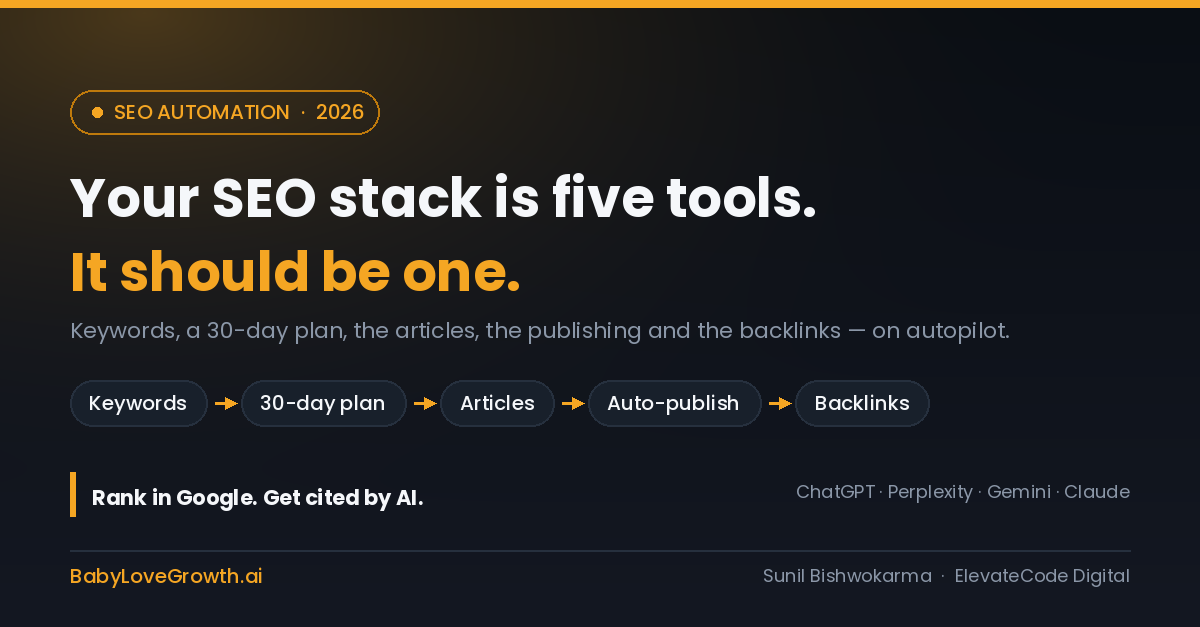
Keywords, plan, articles, publishing and backlinks in a single workflow — with no handoffs to babysit.
Start free 👉 See our SEO automation stack
Start free 👉 babylovegrowth.ai
What consolidation actually looks like
BabyLoveGrowth.ai collapses the five components into one loop. It analyses your site to build the keyword set, turns it into a rolling thirty-day plan, writes each article with headings, internal links, meta tags and schema already in place, pushes it live to your CMS, and builds contextual backlinks from a 4,000-plus site network pointed at the pages it just published.
| Job to be done | Assembled stack | Consolidated platform |
|---|---|---|
| Find keywords | Separate subscription, manual export | Automatic from your site |
| Decide what to publish | You, in a spreadsheet | Dated 30-day plan |
| Write it | Freelancer, 3–7 day turnaround | Draft ready on schedule |
| Put it live | Manual paste and format | Direct CMS publishing |
| Earn links | Outreach or retainer | Network placement |
| Owner | Four handoffs | One pipeline |
When you should not consolidate
Consolidation is a poor decision if competitive intelligence is your job — agencies and in-house SEO teams need the raw datasets that dedicated research suites provide. It is also wrong if your differentiation is original reporting, or if your site has unresolved technical problems, because publishing more pages into a broken crawl path multiplies nothing. Fix indexation first, then scale content.
A sane hybrid
Most small businesses land here, and it is a good place to be:
- Automate keyword discovery, planning, drafting, publishing and base-load link building.
- Keep Google Search Console and analytics — free, and non-negotiable for measurement.
- Buy occasionally a technical audit once or twice a year and a strategist for quarterly direction.
- Do yourself the ten-minute editorial pass per article that adds your prices, your local detail and your opinion.
That hybrid typically costs a fraction of the assembled stack and, far more importantly, publishes every week without anyone chasing it.
How to run the comparison on your own numbers
- List every SEO line item you currently pay, including your own time at a realistic hourly rate.
- Count how many articles actually went live in the last ninety days — not how many were planned.
- Divide the spend by the published count to get your true cost per page.
- Compare that against one subscription and the volume it produces.
For most operators the true cost per published page lands between three and six hundred dollars once idle subscriptions and unplanned delays are counted. That is the number consolidation attacks.
Work out what your stack really costs
Start free, let it build a plan for your site, and compare a month of output against what you are paying now.
Start free 👉 See our SEO automation stack
Start free 👉 babylovegrowth.ai