When you're launching or modernising a taxi, private-hire or chauffeur operation in 2026, one decision decides your next 3 years of cash flow: white-label taxi dispatch software or a custom-built taxi app. Get it right and you're live in weeks with predictable costs. Get it wrong and you burn six months and £150k before your first paid ride.
This guide is the unvarnished, UK-first decision framework — no vendor spin, no "it depends" cop-out. By the end you'll know which side of the fence your fleet belongs on and exactly how to move next.
The One-Line Answer
Choose white-label if you want to launch fast, keep costs predictable and rely on a battle-tested platform with standard features. It's the right call for startups, SMEs, and any operator who wants to spend energy on growing the business rather than building software.
Choose custom-built only if you have unique workflows that no vendor supports, a fleet large enough to justify a dedicated engineering team, and the budget plus patience for a 6–9 month build cycle.
What Is White-Label Taxi Dispatch Software?
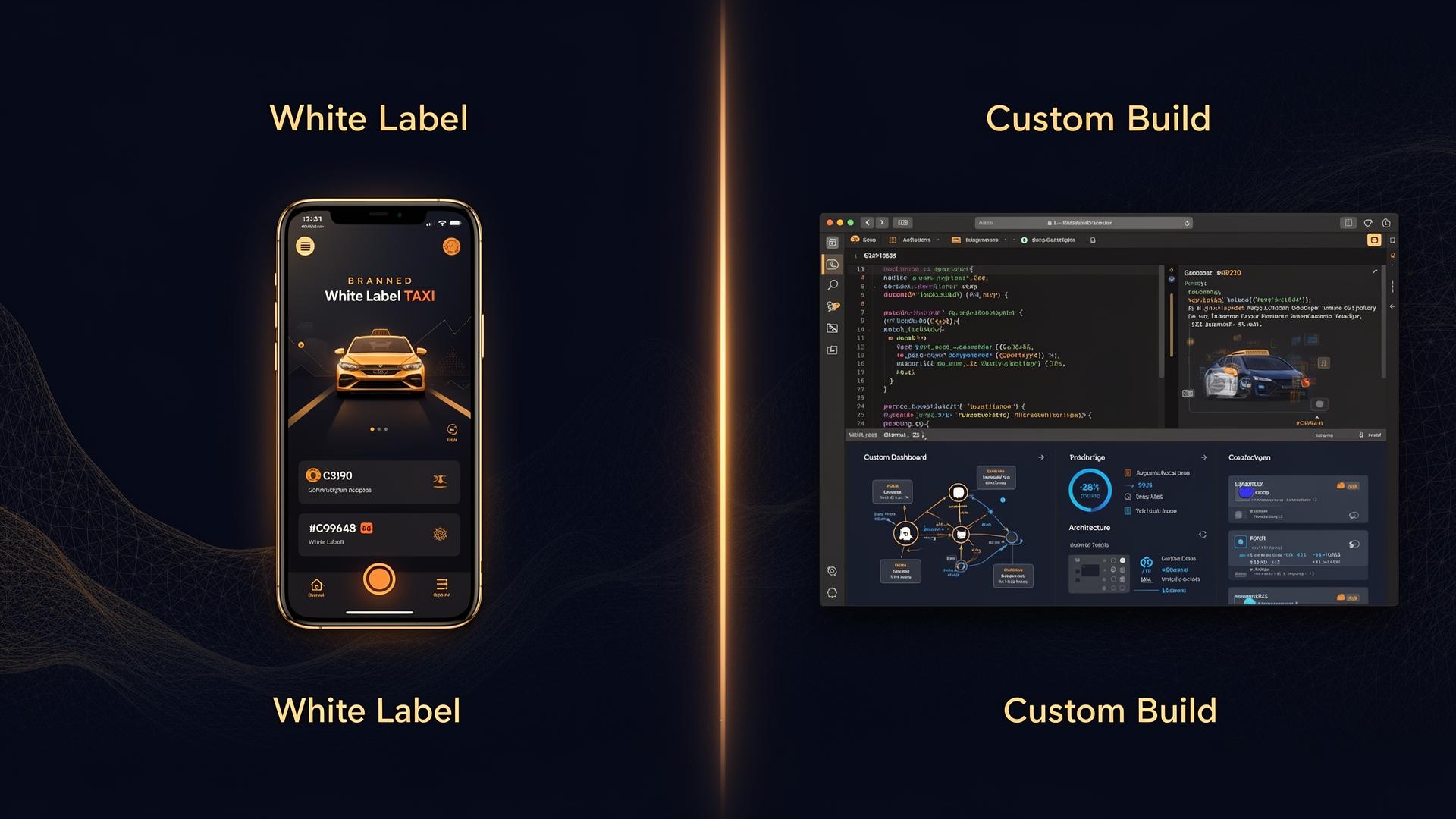
A white-label platform is a pre-built, production-ready taxi dispatch stack — passenger app, driver app, dispatcher console, admin panel, payments, maps, notifications — that is rebranded with your company's name, colours and logo. The core software is already engineered, tested and running for other operators; you get to skip 5+ years of R&D and go straight to serving customers.
Advantages of White-Label
- Faster time to market: Days to weeks, not months. A branded launch in a single city is typically 2–8 weeks including app store submission and driver onboarding.
- Lower upfront cost: Ranges from £399 one-time (basic starter packages) to £8,500 one-time for a fully white-labelled enterprise platform with source code — versus £60k–£250k+ for a custom build.
- Proven functionality: The dispatch algorithm, payment flows, driver tracking and offline behaviour are already stable across thousands of trips. You inherit that reliability on day one.
- Ongoing updates included: Security patches, iOS/Android SDK updates, map provider changes and new features arrive automatically — no separate engineering budget.
- Predictable scalability: The vendor's infrastructure handles surge, holidays and airport peaks. You don't operate a DevOps team.
Disadvantages of White-Label
- Limited customisation: You can change branding and often toggle features, but bespoke workflows or a radically different UX usually aren't possible.
- Dependence on the vendor: Roadmap, uptime and pricing are all decisions the vendor makes. Read the contract for exit clauses.
- Integration limits: Deep integrations with legacy back-office systems, proprietary telematics or unusual payment rails may not be supported.
Best for: Startups, small-to-medium operators, and anyone wanting a quick, cost-effective launch without heavy technical overhead. Also perfect for operators who want to compete with Uber and Bolt without paying 20%+ commission.
What Is a Custom-Built Taxi App?
A custom-built taxi app is engineered from scratch to match your exact business — every feature, screen, algorithm and integration designed specifically for your operation. You (or your dev partner) own the source code, the roadmap and every architectural decision.
Advantages of Custom Development
- Full control & customisation: Every feature, workflow and UI element can be tailored — including proprietary dispatch algorithms or unusual pricing models.
- Complete ownership: You own the source code and IP. No vendor lock-in, no per-seat or per-ride vendor fees eating your margin.
- Deep scalability: Easier to add advanced, proprietary features as you grow — new vehicle classes, region-specific compliance, custom loyalty programs.
- Competitive differentiation: Unique features can genuinely help you stand out in a crowded market — assuming those features actually matter to riders.
- Better legacy integration: Full flexibility to connect proprietary systems, ERPs or bespoke accounting stacks.
Disadvantages of Custom Development
- High upfront investment: £60,000–£250,000+ for a production-grade stack (passenger app, driver app, admin, payments, maps, push, backend).
- Long time to market: Realistic build time is 5–9 months minimum before first paid ride — 12+ months if the scope grows mid-project.
- Development risk: Bugs, delays, staff turnover and shifting requirements are the norm, not the exception. Half of custom-build projects overshoot budget by 40%+.
- Ongoing maintenance: You own bug fixes, iOS/Android updates, security patches and infrastructure — typically £1,000–£5,000/month forever.
- Team dependency: When your lead developer leaves, months of institutional knowledge walks out with them.
Best for: Established companies with complex needs, proprietary algorithms, or a unique business model. Also viable if you have both sufficient budget and the patience to invest in a highly tailored, scalable platform.
Summary Table: White-Label vs Custom (2026)
| Criteria | White-Label Taxi Dispatch | Custom-Built Taxi App |
|---|---|---|
| Time to market | 2–8 weeks (fast) | 5–9 months (slow) |
| Initial cost | £399 – £8,500 | £60,000 – £250,000+ |
| Customisation | Branding + feature toggles | Everything tailored |
| Control | Vendor-dependent | Full ownership of code & IP |
| Scalability | Good for standard growth | Excellent for complex scaling |
| Maintenance | Managed by vendor | Your responsibility (£1–5k/mo) |
| Risk | Lower — tested software | Higher — new build, unknowns |
| Best for | Startups, SMEs, quick launch | Large fleets, unique needs |
In the UK Context
White-label taxi dispatch software is disproportionately popular with UK private-hire operators — and for good reason. Modern platforms ship with the UK-specific plumbing already built in:
- PHV driver licence tracking with automatic expiry reminders.
- DVSA MOT reminders keyed to each vehicle's registration.
- VAT invoicing and Making Tax Digital compatibility.
- GDPR-compliant data handling and UK/EU data residency.
- What3words and Google Maps integrations for rural pickups.
- TfL and local council audit trails that satisfy PCO inspections.
Replicating just this compliance layer inside a custom build takes 6–9 engineer-months. That's before you've written a single line of dispatch or booking logic. It also lets UK operators compete with Uber and Bolt without paying 20%+ commission on every fare — while owning the customer relationship.
How to Actually Decide: A 5-Question Framework
- How fast do you need to launch? Under 3 months → white-label. Over 9 months is acceptable → custom is on the table.
- What's your realistic budget? Under £30k → white-label. Over £100k earmarked for software AND you have the appetite for overrun → custom is viable.
- How unique are your workflows? Standard taxi/PHV/chauffeur operations → white-label covers 95%. Genuinely novel matching or pricing logic → custom.
- What's your fleet size? Under 500 vehicles → white-label scales fine. 500–2,000+ → hybrid. Over 2,000 with unusual constraints → custom becomes defensible.
- Do you want to be a taxi operator or a software company? This is the honest question. Custom-built means you're partly a software company forever.
Still Undecided? Ask a UK Dispatch Specialist on WhatsApp
Send us your fleet size, city and go-live target — we'll tell you honestly whether white-label or custom is the better fit for your operation. No sales pitch, no obligation.
The Hybrid Path (Most Investors' Favourite)
In 2026, tier-1 mobility investors explicitly prefer the hybrid path for pre-seed and seed rounds: launch on white-label, prove the market, then selectively rebuild the 10–20% of the stack that has become a real differentiator. A £2M seed round buys 30 months of runway with white-label and only 9 months with a pure custom build. That capital efficiency is why "we're building our own dispatch from scratch" now reads as a yellow flag unless the founding team already includes a senior engineer who has shipped a comparable system.
Conclusion
- Choose white-label taxi dispatch software if you want to launch quickly, keep costs low and rely on a tested platform with standard features. It's ideal for startups and SMEs focusing on business growth rather than tech development.
- Opt for a custom-built taxi app if your business demands unique features, complete control and you have the resources — time, budget, expertise — to invest in a tailored, scalable solution.
Both options have their place, and the right choice hinges on your specific business strategy and operational needs. For most operators in 2026, white-label wins on speed, cost and risk — and leaves the door open to a hybrid rebuild once you've earned the right to spend engineering money.
Talk to a Real Dispatch Specialist
Prefer a phone conversation? Our team answers on both sides of the Atlantic:
- UK: +44 7453 415289
- USA: (402) 816-6183
- Email: info@taxi-webdesign.com
Related reading: What is white-label taxi dispatch software? · Branded passenger app vs Uber & Bolt · UK private-hire operator software · See enterprise pricing.