The taxi and limousine industry has its own vocabulary — three decades of dispatch jargon, regulatory shorthand, payment acronyms and technology terms layered on top of each other. For new operators, drivers and investors entering the sector in 2026, that vocabulary is a barrier. This glossary fixes it.
Below are the 50 most important terms every operator should know, grouped into five categories: Dispatch & Operations, Booking & Reservations, Driver & Fleet, Passenger & Service, and Technology, Payments & Compliance. Each term is defined in plain English with the operational context that matters in 2026. Internal links throughout connect to deeper guides on our glossary hub, our taxi dispatch software page and our chauffeur software page for limo and black car operators.
1. Dispatch & Operations
1. Dispatch
The process of assigning an incoming booking to a specific driver. In 2026, dispatch is almost always automated — the software evaluates every available driver against the trip, ranks them by ETA, vehicle class, rating and current workload, and offers the job to the best match. Manual dispatch still exists for VIP, corporate and complex pre-bookings, but accounts for under 15% of jobs in modern fleets.
2. ETA (Estimated Time of Arrival)
The predicted minutes until the driver reaches the pickup. Calculated live from GPS, traffic data, route plan and historical pickup-zone delays. ETA accuracy is the operational metric most strongly correlated with passenger satisfaction and the headline number every dispatch console shows to dispatchers and customers.
3. ATA (Actual Time of Arrival)
The real time the driver arrived. The gap between ETA and ATA is the dispatch system's accuracy score — modern platforms target a median variance under 90 seconds. Operators use ATA data to fine-tune their routing, zone definitions and driver allocation rules.
4. Auto-Dispatch
The algorithmic assignment of jobs to drivers without dispatcher intervention. Modern auto-dispatch evaluates dozens of variables in milliseconds — distance, vehicle class, driver rating, acceptance rate, ride history, account preferences and surge zones — and rebroadcasts the job if the first driver rejects or times out. See our deep dive on auto dispatch vs. manual dispatch.
5. Manual Dispatch
The legacy workflow where a human dispatcher reviews each booking and assigns it by name. Slow, expensive and error-prone at scale, but still useful for VIP trips, complex corporate runs and edge cases the algorithm cannot judge. A well-run 2026 fleet uses manual dispatch as an override, not a default.
6. Job Offer
The push notification a driver receives proposing a specific trip — pickup point, drop-off zone, estimated fare and customer rating. The driver accepts or rejects within a short window (typically 10–25 seconds). Acceptance rate is a core driver KPI; fleets with rates above 85% consistently outperform those below 70%.
7. Rebroadcast
When a driver rejects or times out on a job offer, the dispatch system instantly re-offers the job to the next best driver. Modern systems can rebroadcast 4–6 times in under a minute. High rebroadcast counts on a specific job are an early signal of pricing, location or vehicle-class problems.
8. Zone
A geographic area defined inside the dispatch system used for pricing, queueing and driver allocation. Operators draw zones around airports, central business districts, suburbs and high-demand venues. Zone definitions drive surge pricing, queue priority, fixed-fare routes and reporting.
9. Queue
The ordered list of drivers waiting in a specific zone (typically the airport). Drivers join the queue when they enter the zone and receive jobs first-in-first-out. Queue discipline — preventing drivers from gaming their position — is one of the harder operational problems and a feature most modern dispatch platforms solve out of the box.
10. Deadhead Mile
Any mile driven without a paying passenger — repositioning, driving to pickup, returning empty. The biggest hidden cost in a fleet. Successful operators measure paid-mile percentage (paid miles ÷ total miles) and target 65%+ using smart matching and zone strategy.
2. Booking & Reservations
11. ASAP Booking
A request for immediate pickup — "I need a car now." Routed through the live dispatch queue and matched to the nearest available driver. The dominant booking type for taxi and ride-hailing; less common in limo, where pre-bookings dominate.
12. Pre-Booking (Advance Reservation)
A trip scheduled for a future time — anywhere from an hour to months ahead. Pre-bookings are reserved against the driver schedule, automatically dispatched at the right moment and protected by buffer windows to prevent double-booking. The lifeblood of limo, chauffeur and corporate operators.
13. Quoted Fare (Fixed Price)
A fare locked in at booking time, regardless of route or traffic. Standard for limo, airport transfer and corporate work; uncommon in metered street hails. Quoted fares require accurate routing and pricing tables but radically improve customer trust and reduce post-trip disputes.
14. Metered Fare
A fare calculated live as the trip progresses, based on a regulated tariff combining base flag, distance and waiting time. Standard for hackney carriages, yellow cabs and most street-hail operations. Calculated by a sealed taximeter (legacy) or by GPS-based software meters certified by the regulator.
15. Corporate Account
A B2B billing relationship where rides are booked by named employees, charged to a single invoice and paid on net-30 or net-60 terms. Corporate accounts typically deliver 2–4x the lifetime value of retail customers and form the profit core of most limo and black car operations.
16. Cost Centre Code
An identifier (department, project, client matter) attached to each corporate booking so the customer can split invoices internally. Essential for law firms, consultancies and any client where ride costs get billed back. Dispatch software exposes this as a required field on corporate bookings.
17. Booking Channel
The source of a booking — phone, branded app, website, WhatsApp, third-party aggregator, hotel concierge desk. Channel reporting is one of the most actionable views in a modern dispatch system; it shows where bookings come from, conversion by source and the cost-per-acquisition by channel.
18. Aggregator
A third-party platform — Uber, Bolt, Curb, Karhoo, HopSkipDrive — that sends bookings to multiple operators. Aggregators bring incremental volume but at a commission cost (typically 15–30%) and lower brand loyalty. A balanced 2026 fleet treats aggregator jobs as fill-in capacity, not its core book.
19. White-Label Booking Widget
An embeddable form an operator places on their website that captures bookings directly into their dispatch system, without sending the customer to a third party. The most underrated marketing asset a fleet can own — direct bookings have zero commission and the highest repeat rate.
20. No-Show
A booking where the driver arrived, waited the agreed grace period (typically 5–10 minutes) and the passenger never appeared. No-shows are charged a no-show fee. Tracking no-show rate by booking source helps identify low-quality channels and serial offenders.
3. Driver & Fleet
21. Owner-Operator
A driver who owns their own vehicle and contracts with the operator to receive jobs. The dominant model in private hire, chauffeur and most U.S. limo markets. Owner-operators are independent contractors, not employees, and the operator's relationship with them is governed by a service agreement, not employment law.
22. Affiliate Driver
A driver associated with an independent affiliate company rather than the dispatching operator. Used to expand coverage into cities or vehicle classes the operator doesn't directly serve. Affiliate revenue typically splits 70/30 in favour of the originating operator.
23. Fleet Owner
An operator who owns the vehicles directly and employs or contracts drivers to operate them. Higher capital requirement, lower per-trip cost, more control over vehicle standards and branding. The default model for high-end limo operations.
24. Vehicle Class
The category a vehicle is offered in — Standard, Executive, XL/SUV, Luxury, Wheelchair Accessible (WAV), Electric. Dispatch rules match each booking to the appropriate class. Class management drives pricing, marketing positioning and the customer's perceived value of the brand.
25. Acceptance Rate
The percentage of job offers a driver accepts vs. the number offered. A core driver KPI. Below 70% usually indicates cherry-picking, ranking distortion or driver dissatisfaction; sustained above 85% indicates a well-incentivised fleet. Most platforms expose this as a real-time leaderboard.
26. Completion Rate
The percentage of accepted jobs that complete successfully (passenger picked up, dropped off, paid). The complement to no-shows, cancellations and abandoned trips. The leading indicator of operational health alongside acceptance rate.
27. Utilisation Rate
The percentage of a driver's logged-in time spent on paid trips. The single most important productivity metric for both driver earnings and operator profitability. Fleets above 55% utilisation are healthy; below 40% indicates oversupply, weak demand or poor matching.
28. Onboarding
The end-to-end process of bringing a new driver into the fleet — application, document upload (licence, insurance, vehicle registration, background check), training, app activation, first ride. A streamlined onboarding flow is a major recruiting advantage; the best fleets bring a driver from application to first trip in under 72 hours.
29. Document Expiry Tracking
The automated monitoring of driver and vehicle document expiry dates — licence, insurance, MOT, PHV badge, medical certificate. Modern dispatch systems block job offers to any driver with an expired or expiring-soon document and notify both driver and operator in advance.
30. Driver App
The mobile application a driver uses to receive job offers, navigate, communicate with the customer, capture proof of delivery and see earnings. The driver app is where 90% of operator-driver friction lives or dies. A bad driver app loses drivers faster than any pay cut.
4. Passenger & Service
31. Passenger App
The mobile application a customer uses to book, track and pay for rides under the operator's brand. The passenger app is the operator's most important marketing surface — every interaction with it shapes brand perception, repeat rate and referral.
32. Meet & Greet
The chauffeur service of meeting a passenger inside the airport terminal (typically at baggage claim) holding a name board, then escorting them to the vehicle. A standard premium-tier feature and a major differentiator between corporate-grade chauffeur service and ordinary airport transfer.
33. Curbside Pickup
The lower-cost alternative to meet & greet, where the chauffeur waits at the designated airport pickup area and the passenger comes out to the vehicle. Standard for taxi and economy black car; substandard for executive chauffeur.
34. Wait Time
The time between the driver arriving at the pickup and the trip actually starting. Charged at a per-minute rate above the free grace period (typically 5–10 minutes for ASAP, 30–60 minutes for airport pickups with flight tracking).
35. Flight Tracking
The dispatch feature that monitors the passenger's flight in real time and automatically adjusts the pickup time when the flight is delayed or early. Essential for airport transfer credibility; the absence of flight tracking is the #1 customer complaint about cheap airport operators.
36. Hourly Service (As-Directed)
A chauffeur booked by the hour rather than point-to-point. The customer directs the driver throughout the booked window — meetings, errands, multi-stop itineraries. The highest-margin product line for most chauffeur operators, with a typical 3–4 hour minimum and 20% gratuity built in.
37. Roadshow
A multi-stop chauffeur booking, typically for executives meeting investors or clients across a city in a single day. Roadshows blend hourly service with a heavily managed itinerary and are the highest-trust, highest-revenue product a chauffeur operator can deliver.
38. SLA (Service Level Agreement)
The contractual performance commitments an operator makes to a corporate or aggregator client — pickup punctuality, vehicle standards, driver dress code, response time on complaints. Modern dispatch systems track SLA compliance automatically and produce client-facing reports.
39. Gratuity
The tip — discretionary in taxi work, often pre-included in chauffeur quotes (typically 15–20%). Pre-included gratuity removes a friction point at drop-off and is the standard for corporate accounts where the booker isn't present in the vehicle.
40. NPS (Net Promoter Score)
The customer-loyalty metric measuring how likely riders are to recommend the operator. Scored from -100 to +100. Top-tier limo operators target NPS above +60; healthy taxi fleets sit at +30 to +50. NPS is the leading indicator of organic growth.
5. Technology, Payments & Compliance
41. Dispatch Software
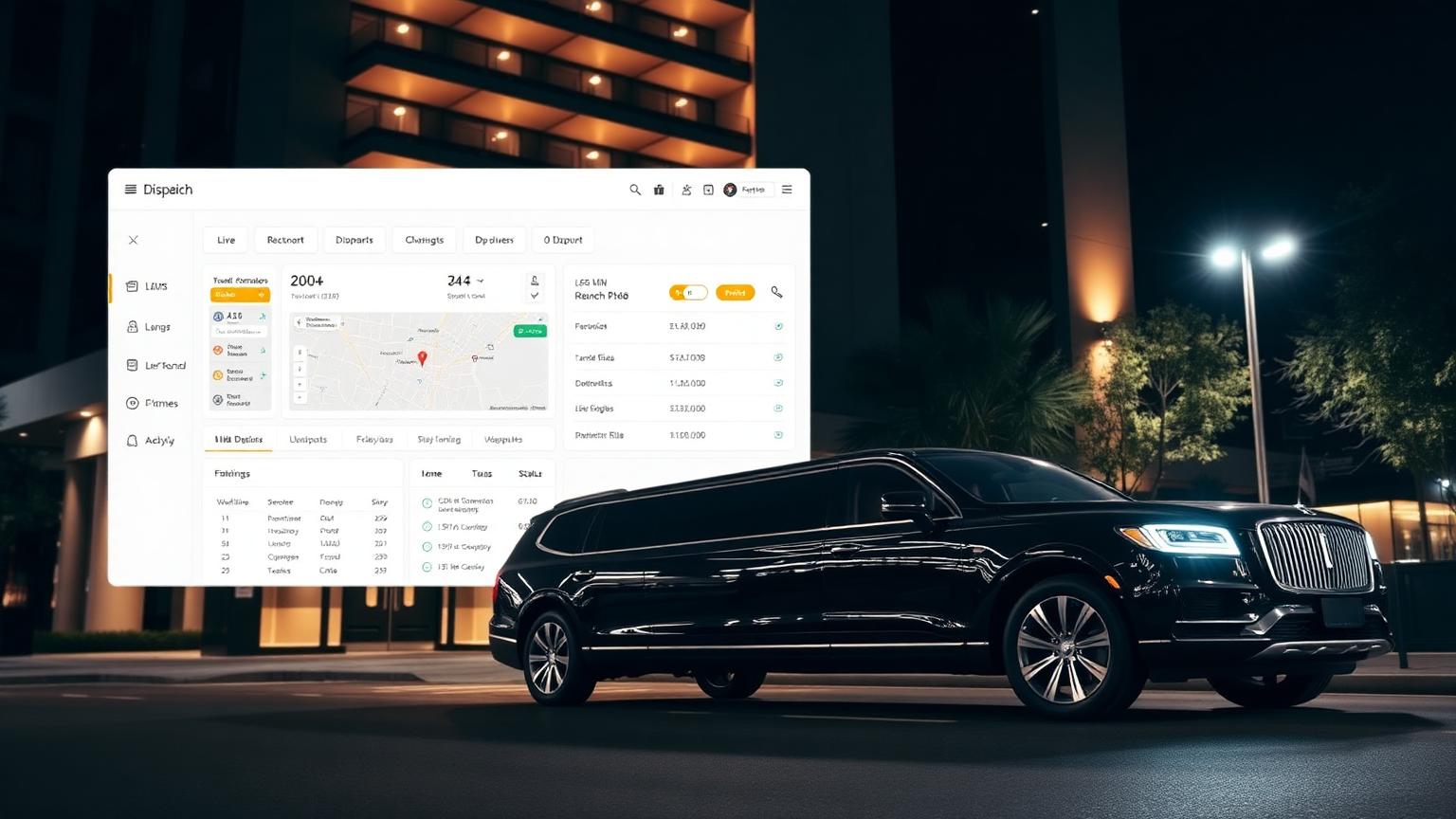
The cloud platform running the entire operation — booking intake, driver allocation, GPS tracking, payments, reporting and compliance. Modern dispatch is SaaS, multi-tenant and updated continuously. See our overview of taxi dispatch software.
42. SaaS (Software as a Service)
A software delivery model where the vendor hosts and maintains the platform and the operator pays a recurring fee for access. The 2026 default for taxi and limo software. The alternative — buying a perpetual licence with one-time pricing — is now offered by only a handful of vendors, including our $8,500 Enterprise plan.
43. White-Label Platform
Production-grade dispatch, driver and passenger software relicensed to the operator under their own brand. The dominant launch path for new operators in 2026. See our white-label platform overview.
44. API (Application Programming Interface)
The programmable interface that lets the dispatch system exchange data with external software — accounting, payment processors, hotel PMS, corporate booking tools, aggregator marketplaces. A well-documented API is non-negotiable for any operator serving corporate clients.
45. Payment Gateway
The service that processes card payments — Stripe, Adyen, Worldpay, Square. The dispatch system tokenises the card and routes the charge through the gateway. Gateway fees typically run 1.4–2.9% per transaction.
46. Tokenisation
Replacing a card number with a meaningless token so the actual card data never touches the operator's servers. The cornerstone of modern PCI compliance and the reason operators can offer one-tap repeat bookings without storing card data themselves.
47. PCI DSS Compliance
The security standard every business accepting cards must meet. Operators using a tokenised gateway fall under the simplest level (SAQ A), which requires self-attestation and an annual questionnaire rather than a full audit.
48. GPS Telematics
The continuous capture of vehicle location, speed and route, used for dispatch, ETA calculation, fare verification, driver behaviour scoring and insurance discounts. Telematics is also the evidence layer that resolves customer disputes and regulator audits.
49. Geofence
A virtual boundary drawn on the map that triggers software actions when a vehicle enters or exits — joining an airport queue, starting a fixed-fare zone, releasing a hold on a corporate account. Geofences are the primitive that makes zone pricing, queueing and event venue management work.
50. KYC (Know Your Customer)
The identity verification process applied to drivers and corporate accounts — government ID, background check, proof of address, vehicle ownership. KYC requirements are tightening in 2026 across most regulated markets and the operator's dispatch system increasingly handles it natively, including biometric checks for drivers.
How to Use This Glossary
If you're new to the industry, read the categories in order — they roughly mirror how an operation actually flows: booking comes in, dispatch matches it, driver delivers it, technology and compliance underpin the whole thing. If you're shopping for software, the Dispatch and Technology sections form the buyer's vocabulary you'll need to compare vendors fairly. If you're training new dispatchers or drivers, the Passenger & Service section is the customer-facing language your team needs from day one.
For operators ready to put this vocabulary into practice, our taxi dispatch software platform implements every concept in this glossary out of the box, and our chauffeur software is purpose-built for limo, black car and executive operators who need the premium-tier features — meet & greet workflows, hourly/as-directed billing, roadshow management and corporate SLA reporting. You can also browse the full glossary index for quick lookups.
Further Reading
- What is taxi dispatch software? (Plain-English explainer)
- How does taxi dispatch software work?
- Auto dispatch vs. manual dispatch
- Best taxi dispatch software for small fleets
- Taxi dispatch software for limo companies
Ready to See These Concepts Working in a Real Platform?
Book a 30-minute demo and we'll walk you through dispatch, driver allocation, corporate accounts, surge pricing, flight tracking and reporting — using your own city, vehicle classes and fare structure as the example.